
Somewhere in northern Arizona there's a trail called the Bright Angel, and the first time I stood at its rim at 5am I had no business being there. Twenty pounds of gear I'd bought the week before, a hip belt cinched so tight I couldn't feel my left leg, and the naive confidence of someone who'd watched too many YouTube videos about adventure travel. I made it 4 miles down. Then I turned around and climbed back up, because I finally understood something nobody tells you: a beginner hike isn't one that's easy. It's one that lets you fail safely.
That's the distinction I want to make here. If you're an adventure travel enthusiast with limited trail experience, the worst thing you can do is pick a route that's gentle but boring. You'll quit. The best beginner hikes are the ones that feel like expeditions—even when they're objectively short—and that leave you an exit if your body or your head gives out before the summit.
Key takeaways
- A beginner-friendly hike is defined by escape routes, not by distance or elevation alone
- Adventure feel usually comes from terrain variety, exposure to weather, and remoteness—none of which require technical skill
- The best first multi-day trips stay under 25 miles total and never go more than a half-day from a road
- A one-way trail beats a loop for beginners: you can always turn around without getting lost
- Anxiety around hiking is common and often unrelated to fitness—and it changes how you should plan
What are the best hiking trails in the world for beginners?
There's no single answer, because "best" depends on what kind of adventure you're after. But there are four routes I keep recommending to people with roughly zero backpacking experience who still want a story worth telling when they get home.
I'll be honest about the failure here: my first recommendation to a friend was the Tour du Mont Blanc. He lasted a day and a half. Too much vertical, too many huts booked solid, and no realistic bail-out point once you're past Les Houches. Lesson learned.
The four I actually recommend
- Bright Angel Trail to Indian Garden, Grand Canyon (USA) — 9 miles round trip, well-maintained, water at two points. Descending into a canyon is a genuinely strange experience the first time.
- Kumano Kodo, Nakahechi route (Japan) — ancient pilgrimage trails through forest and village, with ryokan and bus stops every few hours. You can walk two days or ten.
- Inca Trail short route from Km 104 (Peru) — one day, ends at Machu Picchu through the Sun Gate. Guided, permits required, and the altitude is manageable if you acclimatize first.
- Tongariro Northern Circuit, day one (New Zealand) — volcanic terrain, emerald lakes, and a shuttle at both ends. Weather turns fast, but the track is marked the whole way.
Notice what these have in common: a village, a road, or a shuttle within a few hours of any point on the route. That's the whole trick.
Why the classic "top ten" lists mislead you
Most beginner hike lists rank by scenery. That's backwards. Scenery is a reward, not a criterion—and a route with spectacular views and no bail-out is a trap for someone who's never carried a pack before. Rank instead by how easily you can abandon the plan.
And frankly, some of the most beautiful trails I've walked are terrible beginner choices. The Enchantments in Washington are stunning. They're also a permit lottery with no easy exit once you're in. Skip them for year one.
What is considered a beginner-friendly hike?
Three measurable things, in my view. If a route fails any of them, it isn't beginner-friendly regardless of what a blog post claims.
- Under 1,500 feet of total elevation gain per day for a day hike, or under 2,500 feet for an overnight. Above that, most untrained legs hit a wall.
- One-way, marked, and within cell coverage or a known shuttle route. A loop in dense forest with no signage is not beginner terrain, even if it's flat.
- Weather tolerance. If a single bad afternoon turns the route dangerous—scrambling, river crossings, exposed ridges—it's not for you yet.
I'd add a fourth, softer one: the hike should be finishable in daylight. That sounds obvious. It isn't. I once started a "short" coastal trail at 2pm because the trailhead sign said 5 miles, and I finished with a headlamp, dehydrated, because I hadn't checked the actual terrain profile. Total waste of a good afternoon.
The numbers that matter more than distance
| Metric | Beginner range | Why it matters |
|---|---|---|
| Daily elevation gain | Under 1,500 ft | Cardio limits hit hardest on climbs |
| Distance from a road | Under 4 hours walking | Defines your worst-case exit |
| Pack weight | Under 20 lbs for overnight | Every extra pound compounds on descent |
| Nights out | 1 for the first trip | Sleep deprivation wrecks judgment |
Distance on its own tells you almost nothing. Ten flat miles and ten steep miles are entirely different experiences, and the second one will end your trip.
Why do ADHD people like hiking?
Because hiking gives a wandering brain something to hold onto, continuously and without ambiguity. And I've noticed this in myself and in several hiking partners over the years, so I'll answer it directly rather than pretend the question is odd.
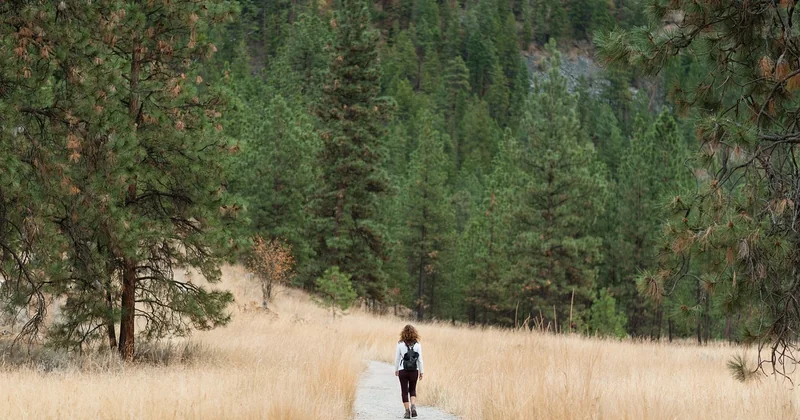
The mechanism is fairly simple. A trail presents a steady stream of small, immediate, physical problems: a root to step over, a route marker to spot, a gradient to manage, a water source to plan around. These are novel, concrete, and time-bound. That combination is exactly what tends to hold attention when longer, abstract tasks don't. There's no meeting to sit through, no inbox, no open-ended decision. Just the next fifty meters of ground.
There's also the movement itself. Sustained rhythmic walking, especially uphill, produces a kind of mental quiet that many people describe as the main reason they keep going back. And crucially—this is the part that matters for planning—novelty resets the effort. A trail you've never walked feels shorter than the same distance on a familiar route. That's a real advantage on a first adventure trip, and it also means day three of the same route can feel three times as long as day one.
What that means practically
If this description fits you, structure your trip around variation rather than distance. Alternate terrain types. Change direction, change elevation profile, change the surface underfoot. Two or three shorter segments with genuinely different character will hold you far better than one long slog on the same track.
And build in an explicit off-ramp. The hardest moment on a beginner trip usually isn't physical—it's the afternoon of day two, when the novelty has worn thin and the pack still weighs the same. Knowing in advance where you'd stop if you needed to makes that hour survivable.
Is Pali Puka illegal?
The short answer is that the Pali Puka trail on Oahu is not a sanctioned, maintained hiking trail—it's an unofficial route on state land, and hiking it is generally discouraged and effectively treated as prohibited access rather than an officially open trail.
Here's the thing: I've seen this question come up often enough that it deserves a proper answer rather than a shrug. The route sits on the Pali Lookout area, which is state-managed. It's steep, eroded, exposed, and there's no maintained path, no signage, no facilities, and no ranger presence. That's what makes it a bad idea for anyone without solid scrambling experience—and genuinely dangerous in wet conditions when the rock and soil get slick.
Beyond the legality, the reason I'd steer any beginner away is simpler: an unmaintained route with real fall exposure and no established bail-out is the opposite of what a first adventure hike should be. There's no shame in it. There are hundreds of legal trails on Oahu that give you a genuine adventure without putting you on a route that no one is coming to maintain or rescue you from quickly.
If what appeals to you is the exposure and the sense of a real scramble, that's a legitimate itch. Scratch it somewhere sanctioned and guided first. You'll learn the movement skills, and you'll learn whether you actually enjoy that kind of terrain when there's no consequence for getting it wrong.
Building your first trip without overreaching
Pick a two-day route under 20 total miles. One night out. A trailhead you can reach by shuttle or a short drive. That's the whole recipe, and I've watched it work for people who'd never slept outdoors in their life.
The mistake I made early on was treating preparation as gear acquisition. I spent real money on equipment before I'd spent a single night out, and half of it I never used again. What actually mattered, in order: a pack that fits, footwear you've already broken in over at least 20 miles of walking, and a plan for water. Everything else is negotiable.
If you want a target to aim at, look at something like the Kumano Kodo's two-day Nakahechi stretch or a short Inca Trail entry. Both are guided or well-serviced enough that a beginner can do them without a mentor, and both deliver that specific feeling—walking somewhere that matters, through terrain that isn't like home—that turns a hike into a trip you'll still be talking about in five years.
Start smaller than you think you need to. Not because you can't handle more, but because the point of a first adventure hike isn't to prove anything. It's to discover what kind of discomfort you enjoy. That answer, once you have it, reorganizes every trip you plan afterward—and you can only learn it by walking the ground yourself.