How to plan a solo backpacking trip when everyone thinks you're going to die
The first time I told my mother I was hiking a two-night loop alone in the Cascades, she asked me to text her from the summit. There is no cell service on that ridge. I know this because I checked, twice, the way you check a pocket for keys you already know are there.
That's the actual problem with your first solo backpacking trip. It isn't the gear, and it isn't the bears. It's that you have no idea whether the thing you're planning is a reasonable weekend or a slow-motion emergency, because nobody you know has done it and the internet is full of people either dying or having the most transformative experience of their lives. Usually both, in the same thread.
So let's build this properly. Concretely enough that you can book a permit by the end of the week and sleep the night before without googling "how dangerous is solo hiking" at 1am.
Key Takeaways
- Plan your first solo trip as a one-night, out-and-back on a trail you already know. The point is to test yourself, not to test your navigation.
- Mileage someone else can walk is not your mileage. Build your first route at roughly 60% of your usual day-hike distance.
- A satellite messenger or personal locator beacon is the single piece of gear that changes what you're allowed to attempt. Everything else is comfort.
- Leave a written plan with a specific person, including your turnaround time and what they should do if you miss it.
- Practice setting up camp and filtering water before you're tired, cold, and losing light.
- Water and resupply logistics dictate your route far more than elevation gain does. Plan around sources, not peaks.
What does solo backpacking actually mean?
Solo backpacking means you carry everything you need to sleep, eat, and stay safe on your back, and you do it without a companion. That's the whole definition. It doesn't require a wilderness area, a long trail, or a life-changing distance from civilization.
People hear "solo backpacking" and picture the Pacific Crest Trail. What it usually looks like in practice is a 12-kilometer loop, one night out, forty minutes from your car. That version counts. I'd argue it counts more, because it's the version you'll actually do again.
Solitude is the product, not the price
Here's what surprised me on my first night alone: the discomfort wasn't fear. It was boredom, briefly, followed by a kind of attention I hadn't experienced since childhood. You notice the light changing. You notice that you're the only thing making noise. Nothing is scheduled and nobody is waiting for you to finish a sentence.
That's the actual draw. Not toughness. If you're chasing the toughness version, you'll quit after night two.
Pick a first route that cannot go wrong
I made this mistake early: I chose my first solo route because the photos were spectacular. It was 22 kilometers with 1,300 meters of gain, on terrain I'd never walked, with one water source I was guessing at. I turned around at kilometer nine, dehydrated and annoyed at myself, and drove home.
Nothing bad happened. But I spent the entire day managing a situation instead of enjoying one, and I nearly concluded that solo backpacking wasn't for me. It was the route. It's almost always the route.
The 60% rule
Take the longest day hike you've done in the last year and feel genuinely good at the end of. Multiply the distance by 0.6. That's your first solo route. If your longest day hike was 15 kilometers, your first overnight is about 9.
Why so conservative? Because a loaded pack changes everything. Add 12 kilograms to your back and the same trail costs you noticeably more. Add uneven footing, a late start, and a three-hour camp setup, and a distance you'd normally laugh at becomes the thing that ruins your trip.
- Distance: 60% of your proven day-hike maximum
- Elevation gain: keep it under 500 meters for night one
- Type: out-and-back, not a loop, so you can retreat on familiar ground
- Distance from your car: under 10 kilometers. Yes, really
- Water: at least one known, reliable source within 3 kilometers of camp
Permits and reservations will decide your plan
In a lot of popular areas, you cannot simply show up. Wilderness permits, quota systems, and designated campsite reservations are the norm across many national parks and heavily used backcountry zones, and in some regions you book months ahead through a lottery. Others require nothing at all.
Check this before you fall in love with an itinerary. I've watched a friend plan six weeks around a route she couldn't legally camp on. The rule itself doesn't matter much for a first trip, since an easy out-and-back near home is almost always permit-free. What matters is that you verify rather than assume.
The safety plan nobody writes down
Search any forum and you'll find the same question about backpacking alone as a woman, and the answers split into two useless camps: "absolutely never" and "just go, you'll be fine." Both skip the part that actually helps. Which is a plan.
Not a vibe. A document.
Leave a real plan, not a text message
Give one specific person: your trailhead, your route, your campsite, your expected return time, and your turnaround decision. Then state explicitly what they should do if you haven't checked in by a set hour. Call the land management agency. Call search and rescue. Do not wait until morning because they assume you're fine.
The turnaround rule matters just as much, and you have to write it down before you leave, because you will not enforce it from a beautiful ridge at 4pm. Mine is simple: if I'm not at camp by two hours before sunset, I stop and camp wherever legal terrain allows. No negotiating.
The device that changes what you're allowed to attempt
A satellite messenger or personal locator beacon is the one purchase I'd make before anything else, ahead of the sleeping bag and the pack. Not because something will go wrong. Because of what its presence does to your decision-making.
Without one, every minor problem feels like it could compound into a real one, and that fear pushes you to turn around early, or to push forward when you shouldn't. With one, you can make calm choices. In my experience it's the difference between a trip and an anxiety exercise.
| Approach | Cost mindset | What it gives you | Best for |
|---|---|---|---|
| Phone only | Free | Maps and photos. No emergency signal off-grid | Day hikes with coverage |
| Satellite messenger | Mid-range device plus a subscription | Two-way texts, weather, SOS button | Most solo backpackers |
| Personal locator beacon | Higher upfront, no subscription | One-way emergency alert only | People who want zero recurring cost |
| What most forums recommend | — | "Just tell someone your plans" | Not sufficient on its own |
Notice that the last row is not a real option. Telling someone your plans is a layer, not a solution.
Water, resupply, and the food-weight problem
New backpackers obsess over base weight and ignore water logistics, which is backwards. Water determines your route. Food determines whether you enjoy it.
Treat water as a route constraint
Map every reliable source on your line. In dry regions, sources listed on maps can be seasonal or gone entirely, so ask locally before you go, or pick a route where you know the water. Carry a filter or treatment tablets and the ability to hold at least 3 liters, more if the gap between sources is long.
Carrying 4 liters of water adds 4 kilograms. That's a real distance tax. A route with frequent sources is easier than a route with none, even if it's longer.
Food, and the caching question
For one or two nights you do not need a food cache. You need about 700 to 900 grams of food per day, which is far less than most people pack. I brought almost two kilos of food on my first solo night and ate maybe a third of it, then carried the rest back to the car like a punishment.
Caches only enter the picture on long routes where you can't carry everything, and in many areas placing them requires permission. For a first trip, ignore the concept entirely.
The progression: from one night to going around the world
Nobody should jump from zero to a multi-month international trip. The people who do it successfully almost always built up in stages, and the stages are boring, which is exactly why they work.
- Night one, near the car. Under 10 kilometers from the trailhead. Test everything.
- A route you've hiked before. Now with a full pack. Same trail, different job.
- A two-to-three night loop. Somewhere with real navigation and one resupply point.
- Europe, Southeast Asia, or a long-distance trail. Only now does booking flights and hostels make sense.
Solo backpacking in Europe
Europe is a genuinely forgiving place to start internationally, and the reason is infrastructure. Trains connect trailheads to towns. Villages sell food. Refuges and mountain huts exist on many routes, so you can hike with a light pack and sleep indoors if the weather turns. Wild camping rules vary a lot by country, and in some places it's illegal or restricted, so check the local situation rather than assuming.
My recommendation: pick a hut-to-hut route in the Alps or a coastal path with villages along the way. You get the solo experience without the self-sufficiency penalty. Save the fully loaded wilderness version for when you've built the skills.
You have to test the gear before you trust it
The mistake I made, and the one I see most often, is buying gear and taking it straight into the backcountry. Pitch the tent in your yard. Sleep in it. Cook a meal on the stove. Filter a liter of water and taste it.
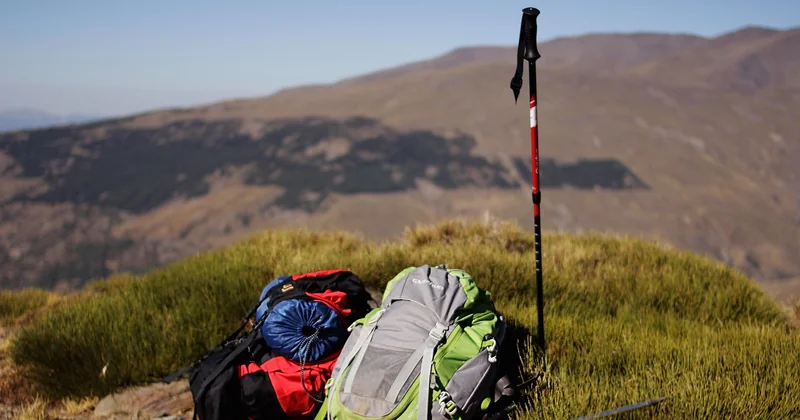
Do this twice. Not because the gear will fail, but because you need to know how it works with tired hands in the dark. The first time I set up my shelter in the field, it took forty minutes and I did it wrong. In my yard, the same setup takes six.
- Pitch and take down your shelter at least twice
- Cook a full meal on your stove, including cleanup
- Walk 5 kilometers with your loaded pack before your trip
- Wear your boots or shoes on a real hike, not around the block
- Sleep one night in your bag and pad at home to check warmth
The week before
Charge everything. Download offline maps for the full area, not just your route. Check the weather three days out, then again the morning you leave, and be willing to cancel. Cancelling is a skill and it is not a failure.
Then pack your bag, put it on, and walk around the block. If something is uncomfortable now, it will be unbearable at kilometer eight.
And when you finally sit at camp with nobody around and nothing to do, you'll probably feel a moment of "why am I here." Stay with it. That feeling passes in about twenty minutes, and what's on the other side of it is the reason people keep going back alone.