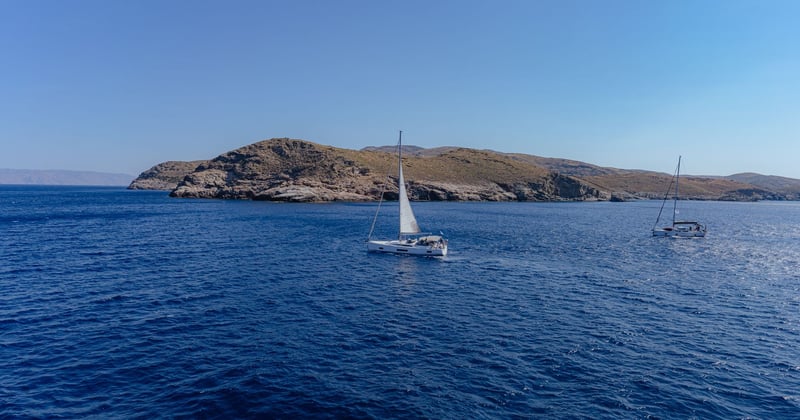
The first time I sailed the Cyclades, I did what most people do: I picked the islands I'd seen on postcards and drew a line between them. Santorini, Mykonos, Naxos. On the chart it looked elegant. Then the meltemi hit on day two, and I spent six hours beating into a headwind to cover a stretch I'd planned as a lazy morning hop. My passenger, who'd never sailed before, spent most of it green and silent. That was the lesson I should have paid for: the best sailing routes in Greece are drawn by the wind, not by the postcards.
So here's a practical guide to Greek island hopping under sail, built around how the weather systems actually work, how far it is between anchorages, and what you'll realistically cover in a week or two. No ferry timetables pretending to be sailing advice.
Key Takeaways
- Pick one archipelago and stay in it. The Cyclades and the Ionian reward completely different plans.
- The meltemi blows hard from the north in midsummer Aegean; the Ionian is gentler and greener.
- A realistic sailing day is 15 to 25 nautical miles, not 50.
- Short island hops (Naxos to Paros is about 20 nautical miles) beat ambitious crossings every time.
- Wind, not distance, decides whether you sail or motor.
- Book a boat with a local charter base, then use its staff for route advice.
What is the best route for island hopping in Greece under sail?
There is no single best route. There is a best route for the month you're going and the wind you're willing to handle. That said, the classic one-week answer for most sailors is the central Cyclades: start at Paros or Naxos, hop between the small Cyclades, and keep your distances short.
Here's why that works. The central Cyclades give you a cluster of islands close together, each with a decent harbour or anchorage, and you can bail out of a bad forecast almost anywhere. Compare that with trying to string together the Ionian and the Aegean in one trip, which means a long delivery leg across open water that eats days.
A concrete central Cyclades plan
This is roughly how I'd do a week, assuming an average boat and a crew that can handle the boat without a skipper:
- Day 1: Paros (Parikia) to Antiparos, a short hop of about 5 to 6 nautical miles to settle in and test the systems.
- Day 2: Antiparos to Ios, roughly 20 to 25 nautical miles depending on your line.
- Day 3: Ios to Santorini. Short, exposed in places; go early before the afternoon breeze builds.
- Day 4: Santorini back toward the small Cyclades — this is where you'll likely motor into a headwind. Give it a full day.
- Day 5–6: The small Cyclades (Koufonisia, Schoinoussa, Iraklia). This is the reward for the earlier effort.
- Day 7: Return to Paros or Naxos to hand the boat back.
Notice the pattern: two longer days, then several short ones. That's deliberate. You don't want three heavy passages back to back with a tired crew. And the small Cyclades are where the trip actually feels like a holiday.
What is the best sailing itinerary for Greece?
The honest answer depends on whether you want the Ionian or the Aegean, and that choice is mostly about wind and scenery. Here's the comparison I wish someone had handed me before my first charter.
| Feature | Ionian (west) | Cyclades (Aegean) |
|---|---|---|
| Dominant wind | Gentle, mostly from the north-west; lighter in summer | The meltemi, strong northerly in July and August |
| Typical hop | 10 to 20 nautical miles | 15 to 30 nautical miles |
| Harbours | Plentiful, sheltered, easy to anchor | Fewer, some exposed to the meltemi |
| Best for | Beginners, families, lazy days | Confident crews who like a challenge |
| Scenery | Green, wooded, low hills | Bare, whitewashed, dramatic |
If you're new to chartering, the Ionian is the smarter first trip. The distances are shorter, the wind is friendlier, and there's a harbour around nearly every headland. The Cyclades are more spectacular and more demanding. In my opinion, sail the Ionian first, then graduate to the Cyclades once you've got a few charters behind you.
The catch? In August the Ionian gets crowded, and the best anchorages fill by early afternoon. Arrive early or accept that you'll anchor further out.
Which Greek islands are the best to sail around?
Different islands suit different kinds of sailing. Here's how I'd group them by what you actually get on the water.
The small Cyclades — for quiet anchorages
Koufonisia, Schoinoussa, Iraklia and Donoussa are the reason to sail the Cyclades at all. They're small, they're quiet, and the anchorages are beautiful. The downside is limited shelter in a strong meltemi, so check the forecast and have a fallback harbour in mind.
The Saronic Gulf — for a short first trip
If you only have three or four days, the Saronic Gulf near Athens is underrated. Aegina, Poros, Hydra and Spetses are close together and the distances are short. Hydra's harbour is one of the prettiest you'll sail into, though it gets busy.
The Dodecanese — for longer passages
Rhodes, Symi, Kos and Kalymnos offer more open-water sailing and fewer crowds, but the inter-island distances are longer and the wind can be tricky. This is a trip for a crew with real sea miles behind them.
Pick your archipelago based on your crew's experience, not your Instagram feed. A confident sailor on the small Cyclades has a better time than a nervous beginner on a long Dodecanese crossing.
What is the cheapest way to go Greek island hopping?
Sailing is not the budget option. The cheapest way to island hop in Greece is by ferry, plain and simple. If cost is your main concern, ferries from Piraeus and Rafina will get you between islands far more cheaply than any charter.
That said, sailing can be surprisingly reasonable if you share the boat. The big costs are the charter itself, fuel, and harbour fees — and those are largely fixed whether one person or six are on board. Split six ways, the per-person cost drops considerably, though I won't quote a figure because it varies wildly by boat, season and base.
A few ways to keep it lean:
- Charter a smaller monohull rather than a catamaran — cheaper to run.
- Sail out of season. May and early June are quieter and cheaper than August.
- Anchor out instead of paying for a berth every night.
- Provision at local markets in the bigger ports before heading to the small islands, where prices climb.
Honestly, the ferry is the answer if money is the deciding factor. Sailing is worth it for the freedom and the anchorages, not the savings.
Practical things that catch people out
Two things consistently trip up first-time charterers in Greece, and both are avoidable.
The wind decides everything
The meltemi is a northerly wind that builds through the summer and can blow for days. When it's up, some harbours become untenable and some crossings turn into a hard beat. Build slack into your plan and be ready to change route. A skipper who insists on sticking to the schedule in a strong meltemi is a skipper who ends up motoring into a wall of chop for hours. Don't be that person.
The boat and the licence
Greek charter rules around what licence you need to skipper your own boat have shifted over the years, and the requirements are best confirmed with the charter company and the relevant authority before you book. Don't rely on a forum post from a few years back. If you're not confident, a skipper is money well spent — and it's usually a legal requirement for boats above a certain size.
One more thing I learned the hard way: a 6 mm shackle key, a spare impeller, and a willingness to ask the charter base's staff for route advice go a long way. They know the local weather patterns better than any guidebook.
The best sailing route in Greece, in the end, is the one that matches the wind you'll actually get and the crew you'll actually have. Pick one archipelago. Keep your hops short. Leave room to change your mind when the forecast turns. The islands will still be there next season — and now you'll know how to reach them.